
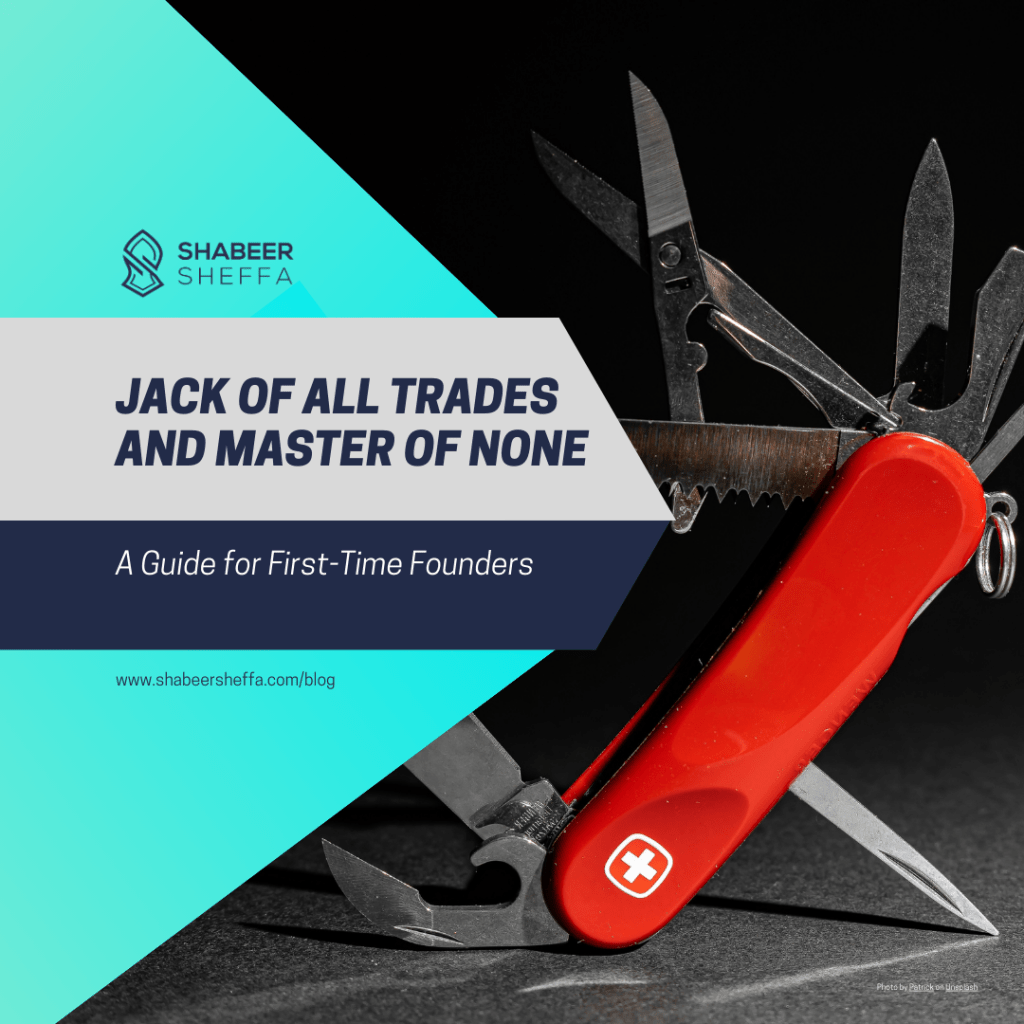
Building a SaaS product as a first-time founder is an exciting and challenging endeavour. As the saying goes, “jack of all trades, master of none,” being a first-time founder often means taking on various roles and responsibilities. In this blog, we will explore the journey of a jack of all trades and how you can navigate the challenges of building a successful SaaS product, focusing on product management, user research, product design, MVP development, sales & marketing, and customer service.
Let’s dissect the journey of a first-time founder, wearing multiple hats.
The All-Encompassing Founder
Being a founder means you’re tasked with an array of responsibilities that cover all spectrums of your startup:
- Product development: Product management is a complex role that requires balancing various factors. You need to define the product’s vision, set goals, prioritize features, and create a roadmap. Finding the balance between user needs, business objectives, and technical feasibility is crucial. Agile methodologies, such as Scrum or Kanban, can help you manage the product development process effectively.
- User research: User research is the foundation of building a successful SaaS product. By conducting surveys, interviews, and usability testing, you can gather valuable insights about your target audience. Understanding their pain points, motivations, and behaviours will help you create a product that resonates with their needs. Iterative feedback loops and continuous testing are essential for refining your product based on user insights.
- Product Design: A vital role in ensuring a seamless user experience. Starting with wireframing and prototyping, you can visualize your product’s flow and interaction. Usability principles and UI/UX best practices should guide your design decisions. Regularly seeking user feedback and conducting usability testing will help you improve the design iteratively.
- Functional MVP: Developing an MVP is a crucial step in the journey of a first-time founder. By focusing on the core features that address your users’ pain points, you can build a functional product quickly. The MVP acts as a testing ground, allowing you to gather feedback and validate your assumptions. Utilize an agile development approach to iterate and improve your product based on user feedback.
- Sales & Marketing: Sales and marketing efforts are essential to drive adoption and growth. Define your target market and develop a compelling value proposition to attract customers. Utilize digital marketing channels, such as social media, content marketing, and SEO, to reach your target audience effectively. Building customer relationships and providing excellent customer service will help you gain customer loyalty and word-of-mouth referrals.
- Customer Service: Once you acquire customers, it’s crucial to provide excellent customer service to ensure their satisfaction and retention. Promptly address their concerns and provide timely support. Actively seek feedback to continuously improve your product and customer experience. Happy customers not only become advocates for your product but also contribute to your long-term success.
If you’re a non-technical founder, add learning to code or understanding technical jargon to the list.
Struggles of Being Jack of All Trades
Though exciting, being a Jack of all trades can also be overwhelming. The challenges include:
- Lack of expertise: Without in-depth knowledge in each field, the quality of work can suffer.
- Lack of focus: With so many things to do, it can be hard to prioritize and stay on track.
- Lack of time: You have to juggle multiple tasks, which can be difficult if you’re not used to it. Lack of focus: When you’re doing everything, it’s hard to focus on one thing at a time.
- Time constraints: With so many roles to fill, there’s often not enough time.
- Scalability: As your company grows, doing everything yourself becomes unsustainable.
The Bright Side
However, there are silver linings. Being a Jack provides:
- Versatility: You become well-versed in a variety of skills.
- Adaptability: You learn how to quickly pick up new skills and adapt to new situations. Problem-solving: You’re able to see the big picture and come up with creative solutions.
- Learning: You’re constantly learning new things, which keeps your mind sharp.
- Independence: You don’t have to rely on others to get things done.
- Problem-solving: With exposure to different challenges, your problem-solving skills are honed.
- Empathy: When you understand every facet of the business, you can empathize with your team better.
Embracing Outsourcing and Delegation
There comes a point, typically with growth, where you, as a founder, need to delegate or outsource:
- Identify your strengths and weaknesses: Knowing what you’re good at and what you’re not can help you ascertain what to delegate.
- Hiring the right team: Finding skilled individuals who align with your vision is crucial.
- Trusting your team: Empower your team to make decisions and take ownership.
In Conclusion
Being a first-time founder and jack of all trades is no easy feat, but it can be an enriching journey. To thrive as a “jack”, you must adapt, learn quickly, and know when to delegate. In many ways, being a “jack” epitomizes the journey of a first-time founder.
Embrace the opportunity to learn and grow in each role, balancing multiple responsibilities to create an exceptional product that solves your users’ pain points and resonates with your target market.
Your first venture may not make you a master, but it gives you knowledge across fields, and with time, you’ll find that you’re not just a jack of all trades, but a master of “some”.
P.S. If you are a first-time founder and looking to turn your idea into a product customers love, or know someone who could benefit from this feel free to reach out to connect on LinkedIn or book a FREE consultation with me.

 Shabeer Sheffa